
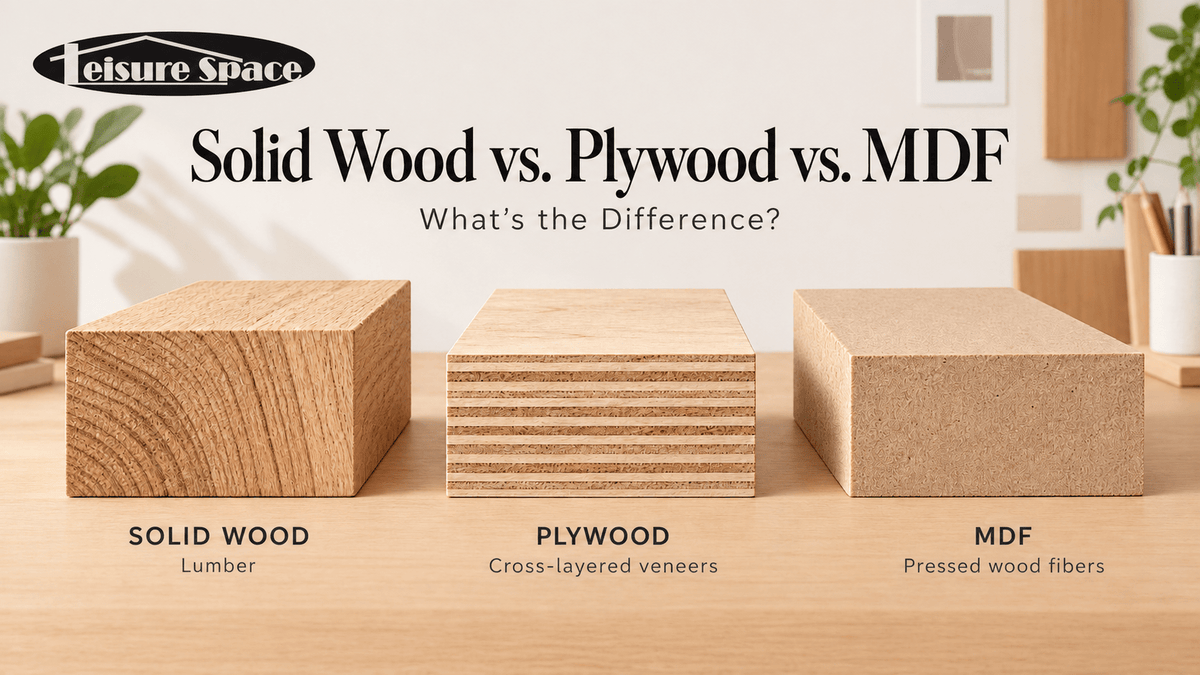
Solid wood is cut from lumber, plywood is made from cross-layered sheets of wood veneer, and MDF is made by pressing wood fibers with resin into a smooth panel. Solid wood gives furniture natural grain and repair potential. Plywood works well when a broad, stable panel is needed. MDF gives painted furniture a flat, consistent surface at a usually lower price.
Any of the three can be the right material. A dining table, painted dresser, curved cabinet, and bookcase place different demands on wood. Thickness, joinery, hardware, finish, and protection from moisture often matter as much as the material name on the product page.
Solid wood vs. plywood vs. MDF at a glance
| What to compare | Solid wood | Plywood | MDF |
|---|---|---|---|
| How it is made | Lumber or glued pieces of lumber | Thin wood veneers bonded in alternating grain directions | Wood fibers and resin pressed into a dense panel |
| Appearance | Natural grain and variation through the material | Layered edges; faces may have a decorative wood veneer | No natural grain; usually painted, veneered, or laminated |
| Dimensional stability | Moves across the grain as humidity changes | Cross-layered construction limits movement across a broad panel | Uniform and stable in normal indoor conditions when properly sealed |
| Fasteners | Usually holds screws well when the species, grain, and pilot hole are suitable | Usually holds face screws well; edge quality depends on grade and ply construction | Face fastening can work well; edges need suitable screws and careful installation |
| Moisture | Can swell, shrink, warp, or crack as moisture changes | Glue rating, veneer species, exposed edges, and finish determine performance | Standard MDF can swell after water reaches an unsealed edge or damaged surface |
| Repair | Often the easiest to sand, touch up, or refinish | Face repairs depend on veneer thickness; sanding through the face exposes lower plies | Paint can be repaired, but swollen or crushed fiber is difficult to restore |
| Weight | Varies widely by species and construction | Varies by wood species, thickness, and number of plies | Often heavy for its size because the fiber panel is dense |
| Typical cost | Often highest, especially in select hardwood species | Middle to high, depending on grade and face veneer | Often lower, especially for painted furniture |
| Common furniture uses | Legs, frames, table edges, drawer fronts, and visible wood surfaces | Cabinet boxes, shelves, drawer bottoms, backs, and wide panels | Painted doors, shaped panels, drawer fronts, shelving, and cabinet parts |
The table describes common behavior, not a quality ranking. Thin low-grade plywood may perform worse than thick MDF in a suitable indoor cabinet. Soft or poorly joined solid wood can also fail before a well-engineered panel.
What is solid wood furniture?
Solid wood furniture uses lumber instead of a fiber or layered panel for the part being described. That part may come from one board or several pieces of the same species glued together. The Architectural Woodwork Institute uses the term solid stock for solid wood that may include pieces securely glued for width or thickness.
The species makes a large difference. Pine, rubberwood, oak, maple, acacia, and walnut do not have the same hardness, density, grain, or price. “Solid wood” alone cannot tell you how easily a tabletop will dent or how much a chair will weigh.
Wood also responds to the room around it. The USDA Wood Handbook explains that wood gains and loses moisture as surrounding humidity changes. This causes swelling and shrinkage, especially across the grain. Good furniture design leaves room for that movement instead of locking a wide solid board rigidly in every direction.
When solid wood makes sense
- You want natural grain that continues through exposed edges.
- You expect to touch up, sand, or refinish the piece in the future.
- The furniture depends on strong legs, rails, or traditional wood joints.
- You are comfortable with grain variation and gradual color change.
Solid wood still needs protection from spills, heat, direct sun, and large humidity swings. A wood label does not make a surface immune to rings, scratches, dents, or seasonal movement.
What is plywood furniture?
Plywood is an engineered wood panel made from layers called plies. According to the Architectural Woodwork Institute definition, the grain direction of alternating plies normally runs at approximately right angles. The balanced, cross-layered structure makes plywood useful for broad panels that need to stay relatively flat.
Plywood quality varies. The number of plies, internal gaps, veneer species, adhesive, thickness, and face grade all affect performance. A furniture-grade panel with a clean hardwood face is a different material from rough sheathing intended to disappear inside a wall.
Exposed plywood edges reveal the stacked layers. Some designers leave those edges visible; other furniture covers them with wood edging, veneer tape, or another finish. A decorative face may look like solid wood from above, so inspect the edge or product specification when construction matters to you.
Where plywood works well
- Wide cabinet sides and backs
- Long shelves that need a stable panel
- Drawer boxes and drawer bottoms
- Curved components made from bending plywood
- Furniture that combines a veneered face with a layered wood core
Plywood is still a wood product. Interior-grade panels and unfinished edges should not be treated as waterproof. A spill can stain the face, reach an edge, or affect the adhesive if the product and finish were not made for that exposure.
What is MDF furniture?
MDF stands for medium-density fiberboard. The U.S. Environmental Protection Agency describes MDF as a panel made from cellulosic fibers that are dry formed and pressed with resin. The fibers create an even surface without knots or visible grain.
That uniform surface is useful for painted furniture. It accepts smooth paint finishes, routed profiles, and repeatable shapes without a wood grain showing through. MDF is common in painted doors, drawer fronts, headboards, shelving, and decorative panels.

Korestone - Square End Table - Dark Brown
MDF has practical limits. Dense panels can be heavy. Repeatedly removing and reinstalling a screw may weaken the same hole, especially near an edge. Standard MDF also reacts poorly when water reaches an unfinished edge or damaged coating. Moisture-resistant grades exist, but that rating must be stated for the exact panel or product.
What does engineered wood mean?
Engineered wood is a broad family of wood-based materials assembled with adhesives, pressure, or both. Plywood and MDF are engineered wood. Particleboard, laminated veneer lumber, and other composite panels also fit under the larger term, although they are made differently and serve different purposes.
A listing that says only “engineered wood” leaves useful questions unanswered:
- Is the material plywood, MDF, particleboard, or a combination?
- Which furniture parts use it?
- What covers the visible surface: paint, laminate, or wood veneer?
- How thick is the panel, and how are the edges sealed?
- What hardware and joinery hold the piece together?

Mixed construction is common and often sensible. A dresser might use solid wood legs, a plywood case, MDF drawer fronts, and a wood veneer that keeps the exterior grain consistent. Each material is doing a different job.
Which furniture material is most durable?
Solid wood usually offers the best repair potential because dents, scratches, and worn finish may be sanded or touched up when enough material remains. Its durability still depends on species, board selection, joinery, and moisture control.
Good plywood gives cabinets and broad panels a useful balance of strength and dimensional stability. Its layered construction reduces the single-direction movement found across a wide solid board. Durability drops when a panel has internal voids, a very thin face, weak edge treatment, or an unsuitable adhesive.
MDF can last well in dry indoor furniture when the panel is thick enough, the load is supported, and all surfaces and edges are sealed. It is less forgiving after water damage or when hardware pulls out of a damaged edge. For a painted cabinet door, MDF may give a cleaner and more stable finish than a solid board with visible grain and seasonal movement.
Before judging durability, check the part that carries the load. A bookcase needs shelves that resist sagging. A dining chair depends on its joints and frame. A dresser needs drawer hardware secured to a suitable panel. The name of the visible surface may have little to do with the part most likely to wear.
What should you check before buying?
- Read the full materials list. Look for the material used in the frame, top, shelves, doors, drawers, and back.
- Inspect the edges and underside. These areas often reveal plywood layers, MDF fibers, solid boards, or surface veneers.
- Test moving parts. Open drawers and doors, then check alignment, hardware attachment, and unwanted movement.
- Match the furniture to the room. Bathrooms, entryways, sunny windows, and dining areas expose materials to different levels of moisture and wear.
- Follow the care instructions. The finish determines which cleaners, polishes, and repair methods are safe.
Furniture containing regulated hardwood plywood, MDF, or particleboard and sold in the United States must meet federal formaldehyde-emission requirements. The EPA consumer guide explains TSCA Title VI labeling for covered composite wood products and finished goods.
Frequently asked questions
Is solid wood always more durable than plywood or MDF?
No. Solid wood often has better repair potential, but species, thickness, joints, finish, and furniture design affect its service life. Quality plywood can be a better choice for a wide cabinet panel, while sealed MDF can work well for a painted door.
Is plywood real wood?
Yes. Plywood is made from thin layers of real wood veneer bonded together. It is classified as an engineered wood because people arrange and glue the layers to create a panel.
Is MDF the same as particleboard?
No. MDF is formed from refined wood fibers. Particleboard is formed from larger wood particles. Their density, surface, machining behavior, and fastener performance differ.
Is MDF a bad material for furniture?
MDF works well for smooth painted surfaces and shaped panels in dry indoor rooms. It is a weaker choice where unfinished edges may get wet or where hardware will be repeatedly removed from the same edge.
How should I care for wood and engineered wood furniture?
Wipe spills promptly, protect surfaces from direct heat, and keep water away from seams and unfinished edges. Use the cleaner recommended for the exact finish. Our furniture maintenance guide covers care for common furniture materials.


Leave a comment
All comments are moderated before being published.
This site is protected by hCaptcha and the hCaptcha Privacy Policy and Terms of Service apply.