
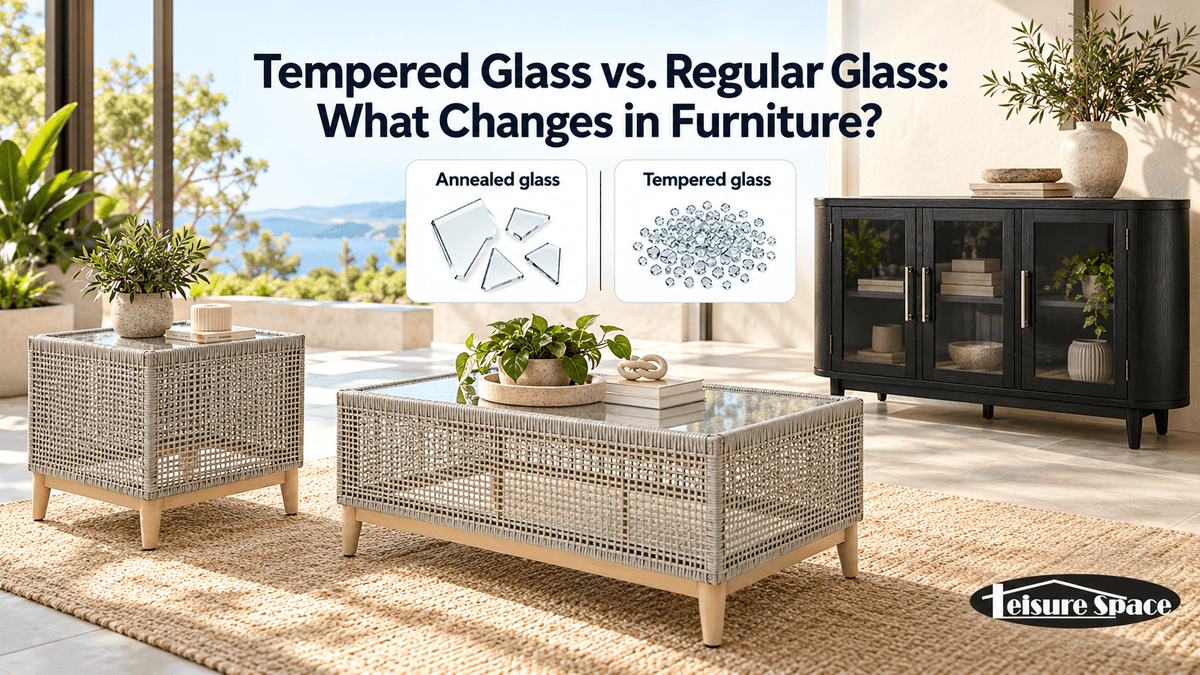
Tempered glass changes how a furniture panel resists stress and, most importantly, how it breaks. Regular annealed glass can fracture into large, sharp shards. Properly tempered safety glass is heat-treated to be stronger and usually breaks into many smaller fragments. That makes tempered glass a more appropriate choice for exposed tabletops and other locations where people could fall against the panel, although thickness, support, edge condition, and intended load still matter.
How tempering changes the glass
Regular flat glass is annealed, meaning it is cooled in a controlled way to reduce internal stress. Tempered glass starts as fabricated flat glass and is reheated, then rapidly cooled. This creates compressive stress at the surfaces and balancing tensile stress inside the pane.
The surface compression makes a tempered panel more resistant to bending and impact than annealed glass of comparable type and thickness. If damage penetrates that compressed outer layer, however, the stored stress can release across the entire panel. This is why tempered glass often appears to shatter all at once.
The most important difference is the breakage pattern
| Characteristic | Annealed glass | Tempered safety glass |
|---|---|---|
| Manufacturing | Slowly cooled to reduce internal stress | Heat-treated and rapidly cooled to create surface compression |
| Typical breakage | Large, sharp shards | Many smaller fragments |
| Relative strength | Baseline strength for the selected glass and thickness | Greater resistance to mechanical and thermal stress at comparable thickness |
| Edge damage | May start a crack that travels across the pane | Can trigger sudden fragmentation of the whole pane |
| Cutting after manufacture | Can be cut or drilled by a qualified glass professional | Cannot be cut or drilled after tempering |
| When broken | High risk of serious cutting and piercing injuries | Reduced cutting and piercing risk, but fragments can still injure |
Tempered glass should never be described as unbreakable. Nor should its smaller fragments be called harmless. Safety treatment reduces the severity of a common breakage hazard; it does not remove every risk.
Inside a Tempered Glass Panel
Tempered glass is a single solid pane. Heat treatment creates different internal stress zones rather than separate physical layers.
Why breakage spreads: If a crack penetrates the compressed surface and reaches the tension zone, the stored stresses can release throughout the pane, causing tempered glass to fragment into many small pieces.
Why the edge matters so much
The broad face of a properly supported tempered panel can withstand substantial everyday use, but its edges and corners remain vulnerable. A hard point impact from a metal object, ceramic planter, exposed fastener, or damaged frame can initiate failure. Chips along an edge deserve attention even when the rest of the pane looks intact.
Furniture design helps manage this risk. A frame can shield the perimeter, pads can keep glass away from hard metal contact, and polished edges remove fabrication defects that would otherwise concentrate stress. Those details do not make the panel immune to impact, so avoid striking the edge while vacuuming, rearranging furniture, or moving the glass.
Tempered glass is stronger, but load capacity remains product-specific
Glass type alone does not tell you how much weight a table can support. Capacity also depends on panel thickness, span, shape, cutouts, support points, frame stiffness, hardware, and whether the load is spread out or concentrated in one spot. A thick tempered top resting on a continuous frame behaves differently from a thin panel supported only at four corners.
Follow the furniture manufacturer’s published capacity and assembly instructions. Do not sit, stand, or climb on a glass tabletop. Concentrated impact from a dropped object can be more damaging than a heavier load distributed across a broad base.
Heat resistance does not eliminate the need for trivets
Tempered glass generally tolerates temperature differences better than annealed glass, but a furniture top is still part of a complete product. Surface coatings, decorative layers, adhesives, pads, and the supporting frame may have lower heat limits. Small scratches and edge damage can also affect performance.
Use a trivet or heat-resistant pad beneath hot cookware, heaters, fire features, and serving dishes unless the furniture manufacturer expressly permits direct contact. Avoid sudden temperature changes, such as placing a very hot container on a cold or wet outdoor tabletop.
All fabrication happens before tempering
ASTM C1048 states that cutting, edgework, drilling, notching, grinding, and other fabrication must be completed before heat strengthening or tempering. Finished tempered glass cannot be trimmed or drilled later. Trying to add a cord hole or resize a tabletop can cause immediate fragmentation.
Replacement panels therefore need to match the original dimensions, thickness, edge profile, holes, and safety-glass specification. Do not substitute a same-size piece of ordinary window glass.
Where laminated glass fits
Laminated safety glass uses an interlayer that helps hold broken pieces together. It has a different failure behavior from tempered glass and may be selected when retaining fragments is important. Some laminated panels also use heat-treated glass plies.

The current ASTM F2813-18(2023) specification addresses unenclosed horizontal glass surfaces below 44 inches in desks and tables. It calls for tempered or laminated safety glass meeting its referenced performance criteria, with limited exceptions for glass that is fully supported and bonded to another material.
Can you identify tempered glass at home?
A permanent manufacturer’s mark may identify a pane as safety glass, and polarized lenses sometimes reveal stress patterns created during heat treatment. Neither observation should be used as the sole basis for modifying, replacing, or loading furniture. Marks can be hidden by a frame, while visual stress patterns can be difficult to interpret.
Check the product specification, assembly manual, label, or manufacturer record. If the documentation is unavailable, a qualified glass professional can help evaluate the panel. Do not perform an impact, heat, scratching, or drilling test at home.
Glass serves different jobs in different furniture
The Seton Creek Square End Table in Gray and Seton Creek Rectangular Cocktail Table in Gray use tempered glass tabletops over woven outdoor frames. The Rowanbeck Dining Room Server in Black uses glass within three framed cabinet doors instead of as a horizontal load-bearing surface. Those placements expose glass to different forces, so shoppers should verify the specification for the exact component rather than assuming every pane in a piece of furniture has the same treatment.

Frequently asked questions
Is tempered glass impossible to break?
No. It is stronger than comparable annealed glass, but severe face impact, edge damage, improper support, manufacturing defects, or extreme temperature differences can still cause failure.
Is every glass tabletop tempered?
No. Current furniture standards favor tempered or laminated safety glass for exposed horizontal surfaces within their scope, but older products, exceptions, and products from different markets may vary. Verify the exact item.
Can I place a hot pan directly on tempered glass?
A trivet is still the safer choice. The glass may tolerate heat better than annealed glass, but coatings, supports, and rapid temperature changes can introduce other risks.
Can a chipped tempered tabletop still be used?
Edge chips can weaken the pane and may lead to sudden breakage. Stop using the surface, keep people away from it, and ask the manufacturer or a qualified glass professional about replacement.
Can I replace tempered glass with acrylic or regular glass?
Do not change materials without the furniture manufacturer’s approval. A substitute may flex differently, fit the hardware incorrectly, or fail to provide the intended safety performance.
Sources
- ASTM F2813-18(2023): Glass Used as a Horizontal Surface in Desks and Tables
- ASTM C1048-25: Heat-Strengthened and Fully Tempered Flat Glass
- National Glass Association: Laminated Glass Use in Furniture


Leave a comment
All comments are moderated before being published.
This site is protected by hCaptcha and the hCaptcha Privacy Policy and Terms of Service apply.