
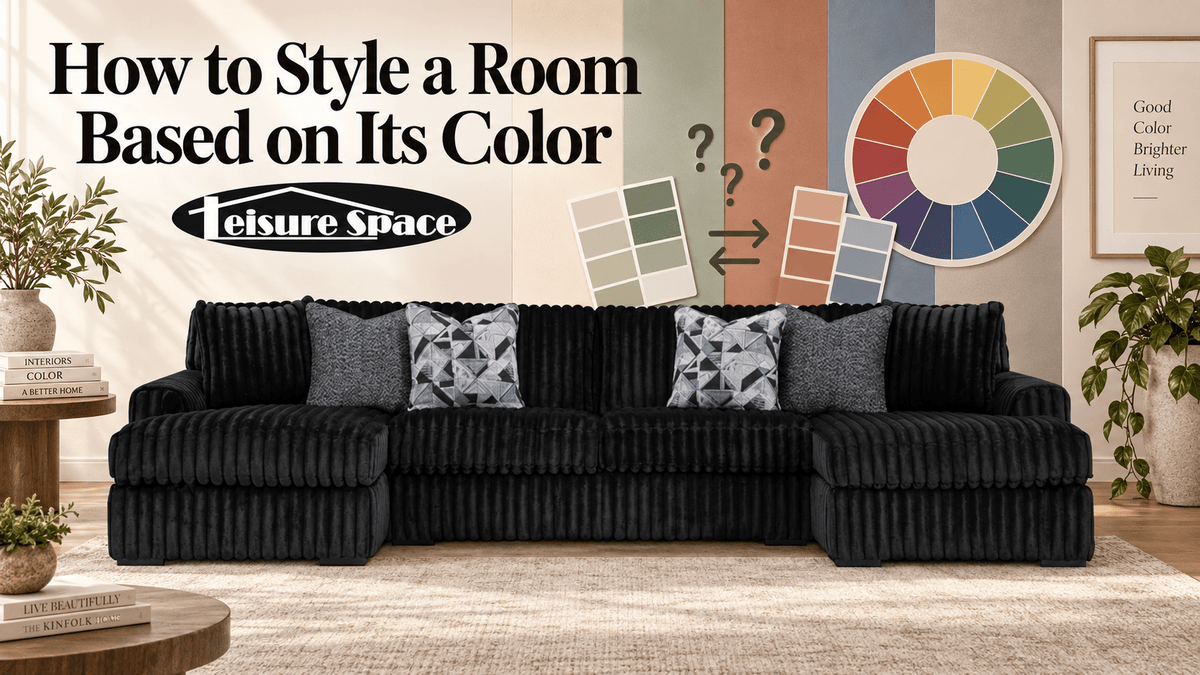
If you plan to repaint, choose the wall color first, then select furniture that works with the walls, flooring, and natural light already shaping the room.
Painting takes time, materials, preparation, and sometimes professional labor. Changing it again after the furniture arrives can create another round of work. Once the paint is decided, you have a stable background for comparing upholstery, wood finishes, metal, rugs, and decor.
If the walls are staying as they are, start with their current color instead. The goal is the same: make the largest fixed surfaces part of the furniture decision.
Start with the colors that are hardest to change
Look at the room before shopping. Wall paint matters, but so do the floor, stone, tile, cabinets, and window coverings. Write down the colors and undertones that will remain.
- Check the paint in morning, afternoon, and evening light.
- Compare it under the lamps you normally use at night.
- Notice whether the flooring reads warm, cool, or neutral.
- Take clear room photos and keep a paint chip or sample nearby while shopping.
A gray wall can lean blue, green, violet, or beige. A white wall can look crisp, creamy, or slightly gray. These undertones often matter more than the broad color name printed on the paint can.
What is color theory?
Color theory is a way to describe how colors relate to one another. A color wheel places hues in a circle so you can see which colors sit next to each other and which sit across from one another.
- Analogous colors sit next to each other on the wheel. Blue, blue-green, and green can create a gentle transition.
- Complementary colors sit across from each other. Blue and orange are one example. One color can lead while the other appears in smaller accents.
- Monochromatic schemes use lighter and darker versions of one hue. Texture and material keep the room from feeling flat.
- Neutral schemes rely on colors such as cream, gray, brown, black, and white. Their warm or cool undertones still need to work together.
You do not need to reproduce a color wheel in your living room. Use it to narrow the choices when two finishes seem equally possible.
How to match furniture with common wall colors
| Wall direction | Furniture colors to try | What to check |
|---|---|---|
| Warm white, cream, or beige | Warm brown wood, camel, rust, olive, soft black, or textured cream | Avoid mixing a very yellow cream with icy gray unless another element connects them. |
| Cool white or cool gray | Charcoal, black, blue, cool taupe, pale oak, or controlled warm accents | Check whether blue or violet undertones become stronger at night. |
| Green | Natural wood, cream, tan, black, muted red, or clay-colored accents | Blue-green and yellow-green walls can call for different wood tones. |
| Blue | White, gray, natural wood, camel, or small orange and rust accents | Dark blue walls may need lighter upholstery or reflective surfaces to keep visual balance. |
| Terracotta, rust, or warm red | Cream, walnut, olive, muted blue, charcoal, or black | Let the wall carry the strongest warm color and repeat it sparingly elsewhere. |
| Bold or very dark color | Lighter neutrals, medium wood, glass, metal, or one related saturated color | Test large furniture against the wall because contrast looks stronger at full scale. |
Should the furniture match the walls?
The furniture should relate to the room without disappearing into it. Exact matching can make large pieces blend together, while strong contrast can make every item compete for attention. A practical middle ground is to repeat one wall undertone in the furniture, rug, pillows, artwork, or wood finish.
Texture also changes how a color reads. A smooth black table, a woven charcoal sofa, and a dark-stained wood cabinet may share a similar value but feel quite different. Compare the material as well as the color name.

Midnight-Madness - Sectional - Onyx
A simple order for styling the room
- Choose or confirm the wall color.
- Record the flooring and other fixed finishes.
- Select the largest furniture piece, such as the sofa, bed, or dining table.
- Add the remaining furniture with related undertones or deliberate contrast.
- Use rugs, pillows, lighting, and artwork to connect the palette.
- View everything in the room's actual daylight and evening light before removing labels or packaging.
Finding furniture for your room at Leisure Space
Begin with the room you are furnishing and compare the listed color options for each product. Browse living room furniture, dining room furniture, or bedroom furniture while keeping your wall sample and room photos close by.
Online images are useful for narrowing the list, but screens and room lighting can change how a color appears. Check the product's written color and material details. If two options are close, contact Leisure Space before ordering or compare them during a showroom visit when practical.
Frequently asked questions
Should I paint before buying furniture?
If repainting is already part of the plan, choose the paint first. It gives you a fixed background for comparing furniture. If you already own a major piece that must stay, use its color and material when selecting the new wall color.
Does all the furniture in a room need to match?
No. Pieces can have different finishes when they share an undertone, repeat a color, or create a clear contrast. Repeating one or two colors across the room usually feels more natural than buying every item from a matching set.
How many colors should a room have?
There is no required number. Start with the walls and the largest furniture piece, then add supporting colors only when they have a clear purpose. A small room may use several colors successfully when their undertones work together.
Why does furniture look different at home than it did online?
Screen settings, photography, daylight direction, bulbs, and nearby colors can all change how a finish appears. Use the written product details and compare the piece in the room's normal lighting whenever possible.



Leave a comment
All comments are moderated before being published.
This site is protected by hCaptcha and the hCaptcha Privacy Policy and Terms of Service apply.