
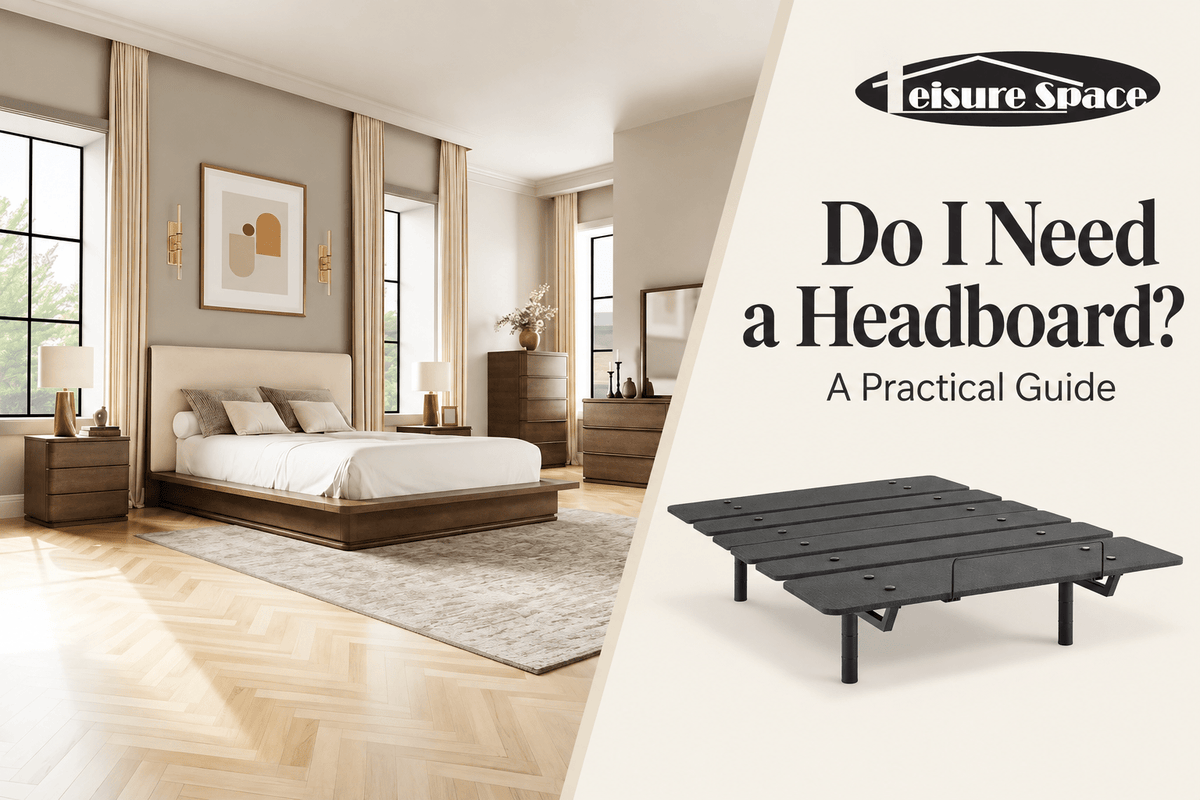
No, you do not need a headboard for every bed. A headboard can make sitting up more comfortable, protect the wall, add storage, and give the bed a finished appearance. Our team at Leisure Space recommend that you do not a headboard if you prefer a simpler room, move often, have limited space, or use an adjustable base that works on its own.
The right choice depends on how you use the bed, how much wall and floor space you have, and whether the headboard is compatible with your frame or adjustable base.
What does a headboard actually do?
A headboard is attached to the bed frame, mounted on the wall, or placed behind the bed. Its role can be practical, decorative, or both.
- It creates a surface to lean against when reading or watching television in bed.
- It can reduce direct contact between pillows and the wall.
- It establishes a visual focal point and helps define the bed area.
- A bookcase or storage headboard can hold small items within reach.
- Some models coordinate with matching nightstands, dressers, or a complete bed frame.
A headboard does not replace the structural support required by the mattress. The bed frame, foundation, platform, or adjustable base must support the mattress according to the manufacturer's instructions.
Headboard types compared
| Type | Why people choose it | What to check | Best fit |
|---|---|---|---|
| Upholstered | Padded surface, softer appearance, and a more comfortable place to lean. | Fabric care instructions, padding thickness, dust exposure, and clearance if used near an adjustable mattress. | Readers, television watchers, and bedrooms where softness matters. |
| Solid wood, wood veneer, or MDF | Firm surface, visible wood tones, and styles ranging from simple panels to detailed frames. | Identify the actual construction. Solid wood, veneer over an engineered substrate, and painted MDF are different materials. | Rooms where a firm surface and wood finish suit the design. |
| Bookcase or storage | Built-in shelves or compartments can hold books, a phone, or small bedside items. | Overall depth, shelf height, outlet access, tipping or anchoring instructions, and whether stored items could fall. | Small rooms that need accessible storage. |
| Metal | Open visual profile and decorative shapes without thick upholstery. | Spacing, exposed hardware, stability, and possible contact noise against the wall. | Compact rooms and traditional, industrial, or minimalist interiors. |
| Wall-mounted | Position can be independent of the bed frame, and the floor below remains clear. | Wall structure, mounting hardware, final height, lease restrictions, and safe installation. | Custom layouts and rooms where the bed frame lacks mounting points. |
| No headboard | Lower visual weight, fewer parts, and easier rearrangement. | Wall protection, pillow movement, and whether you need another surface for sitting up. | Studios, dorms, frequent movers, and adjustable-base users who prefer a simple setup. |
Why choose an upholstered headboard?
An upholstered headboard is useful when you regularly sit up in bed. Padding provides a softer contact surface than wood or metal, while the fabric can add color and texture to the room. The tradeoff is maintenance. Fabric collects dust and may need vacuuming or spot cleaning according to its care code.
The Zoey Bed shows how an upholstered headboard can be part of the bed's overall design. Its current product listing identifies a cream linen upholstered headboard with a brown oak base. It is offered in Queen and King sizes. The Queen is listed at 93 inches long, 79 inches wide, and 48 inches high; the Eastern King is 94 inches long, 93 inches wide, and 48 inches high.
Those dimensions also show why the mattress size alone is not enough when planning a room. Measure the complete bed, including the headboard, side rails, and platform.
When does a wood headboard make sense?
Wood and wood-look headboards provide a firm surface and can visually coordinate with dressers and nightstands. They are often easier to dust than upholstered models, although the correct cleaning method depends on the finish.
A hard headboard may feel less comfortable when you sit against it, so pillows are usually needed. Check whether the listed material is solid wood, veneer, MDF, particleboard, or a combination. These constructions can differ in weight, finish, repair options, and price.
Is a bookcase headboard useful?
A bookcase headboard can replace some bedside storage when the shelves are large enough for the items you use. It works best when the added depth does not make the bed too long for the room.
Before buying one, check:
- The complete bed depth, including the shelves.
- Whether the shelves block outlets or switches.
- How cords will reach lamps and chargers.
- Whether the manufacturer requires wall anchoring.
- Whether items can stay secure when the bed or wall is bumped.
Can I use a power adjustable base without a headboard?
Yes. An adjustable base supports the mattress and works without a headboard. Adding a headboard is optional, so you can keep the setup simple or add one later if you want a more finished bedroom look.
The Cosmic Power Base from Ashley Sleep raises the head and foot of the mattress and includes USB charging. It comes in Full, Queen, King, California King, and Twin Long sizes. Used on its own, it keeps the area around the bed visually open and avoids the extra depth of a headboard.
If you want to add a headboard, contact us before ordering so the team can check the bracket and spacing needed for your base size. For shoppers who prefer a complete bed with a built-in headboard, the Zoey Bed offers a cream linen upholstered headboard with a brown oak base. Choose between these products as separate bedroom setups.
What should I check before adding a headboard to an adjustable base?
Adjustable bases move the head of the mattress, so clearance matters. Some manufacturers sell model-specific brackets, while other bases work inside compatible bed frames. Thick upholstery or a frame with storage can interfere with movement.
- Confirm that the adjustable base manufacturer permits a headboard.
- Use the bracket specified for the exact base model and size.
- Check whether the brackets are included or sold separately.
- Allow the clearance required by the manufacturer's manual.
- Raise and lower the base slowly after installation to check for rubbing, pinching, or blocked movement.
Reasons to skip a headboard
A headboard may add little value if you rarely sit up in bed or prefer an uncluttered room. Skipping it can also help when:
- You move frequently and want fewer large pieces.
- The bed sits below a window or on a short wall.
- A thick headboard would reduce walkway clearance.
- You use pillows or a removable back cushion when sitting up.
- Your adjustable base is designed to stand alone and you do not need a decorative surround.
If pillows mark the wall, consider washable wall protection, a slim wall-mounted panel, or enough space between the bed and wall for easier cleaning.
How to decide
- Start with function. Decide whether you need back support, storage, wall protection, or mainly a visual focal point.
- Measure the full footprint. Include the headboard thickness and any shelf depth, not only the mattress size.
- Check construction. Confirm the upholstery, solid wood, veneer, MDF, metal, or mixed materials.
- Verify attachment. Identify whether the headboard mounts to the frame, wall, or adjustable-base brackets.
- Plan for movement. Renters, students, and adjustable-base users may benefit from a lighter or headboard-free setup.
Frequently asked questions
As a College Student in a Dorm, Should I Buy a Headboard?
Usually not. A simple frame or approved dorm bed setup is easier to move and takes up less space. Before adding a freestanding or wall-mounted headboard, check residence hall rules, bed dimensions, and whether attaching anything to the wall is allowed. A removable padded cushion can provide back support without becoming another large item to transport.
What Should I Consider First As a New Homeowner?
Choose the mattress support and bed dimensions first. Then decide whether the room needs an upholstered, wood, storage, or wall-mounted headboard. Waiting until the bed and nightstands are positioned helps you select the correct width, height, material, and outlet clearance.
Is a headboard practical in a Southern California studio apartments?
It depends on the layout. A slim upholstered or wall-mounted headboard can define the sleeping area without adding much depth. A bookcase headboard may add storage but can make the bed longer. A headboard-free adjustable base or simple platform can be easier when walkway space, windows, and frequent rearrangement matter.
Does a headboard stop pillows from falling?
It can reduce the open gap behind the mattress, but the result depends on the headboard position, mattress height, and frame design. Measure the gap and follow the manufacturer's installation instructions.
Can every headboard attach to every bed frame?
No. Mounting-hole spacing, frame width, bracket type, headboard weight, and adjustable-base clearance vary. Confirm compatibility for the exact headboard, frame, mattress height, and base before purchasing.
Sources
- Leisure Space: Zoey Bed specifications
- Leisure Space: Cosmic Power Base specifications
- Tempur-Pedic: upholstered headboard clearance with an adjustable base
- Saatva: adjustable-base and bed-frame compatibility considerations
- Sleep Number: model-specific headboard bracket installation and clearance
Article information
This article provides general furniture shopping information. Product specifications, compatibility, availability, pricing, materials, services, and delivery timing can change. Confirm current details on the product page or with Leisure Space before purchasing. Follow the manufacturer's installation, clearance, and safety instructions for the exact headboard, frame, mattress, and adjustable base.

Leave a comment
All comments are moderated before being published.
This site is protected by hCaptcha and the hCaptcha Privacy Policy and Terms of Service apply.