
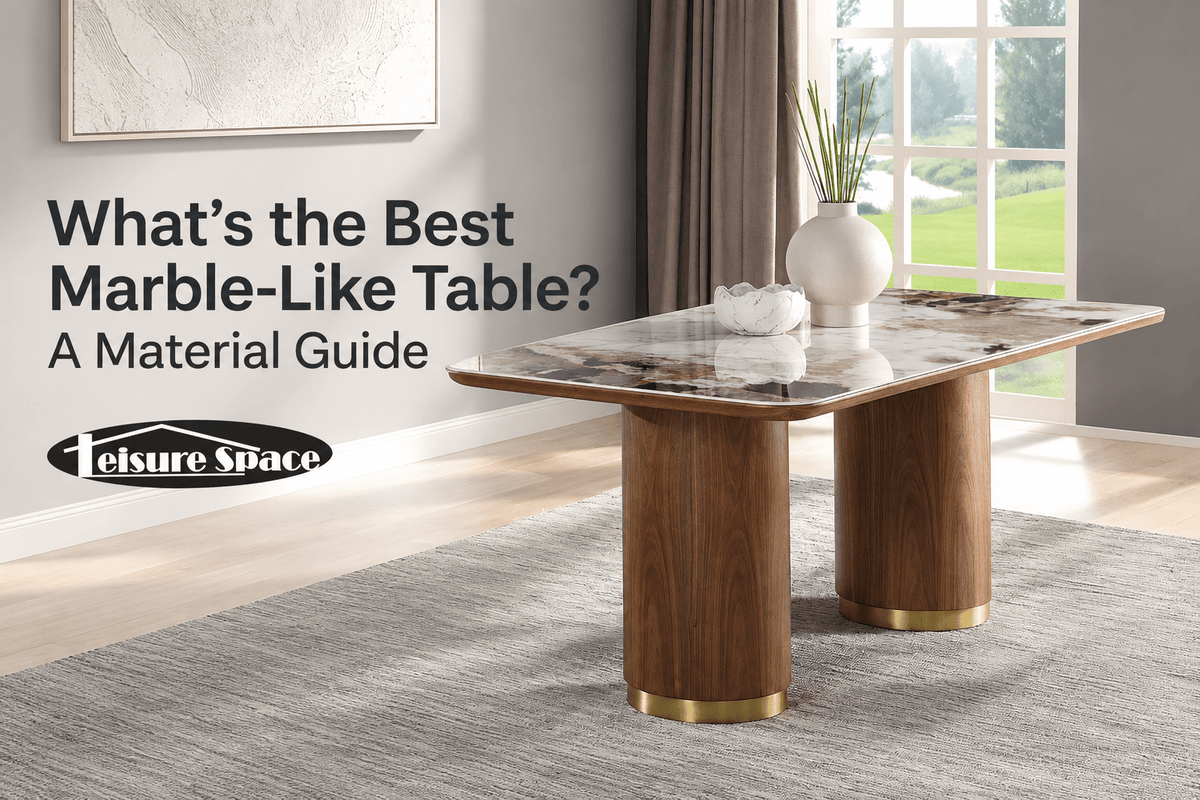
For most homes, our team's best marble-like table choices are ceramic and sintered stone because they are easy to clean, handle everyday heat well, and usually cost less than natural marble. Both can reproduce the veining and color of marble without the weight, porosity, and care needs of a natural marble slab. They are still hard, brittle surfaces, so neither one is shatterproof.
Natural marble remains the right choice when the stone itself matters most. Marble-look veneer or laminate over wood costs less and can handle some bumps, while a marble-effect coated metal top has a metal core but depends on its finish for appearance and surface protection.
Which marble-like tabletop is best?
Ceramic and sintered stone give most households the most useful balance of appearance, cleaning, heat resistance, and price. The right choice still depends on how the table will be used. A formal dining room has different needs from a breakfast table used every day by children.
| Material | What it is | Typical cost position | Daily care | Heat and impact | Best fit |
|---|---|---|---|---|---|
| Natural marble | Natural stone with unique color and veining | Usually highest | Wipe spills quickly; some marble may need periodic sealing | Heat resistant, but hard impacts can chip or crack it | Buyers who want real stone and accept its weight and care |
| Ceramic | A fired surface that can carry a printed marble pattern | Usually below natural marble | Easy to wipe clean; follow the maker's cleaner instructions | Handles heat well; thin tops and exposed edges can chip under a hard impact | Everyday dining with a convincing marble look |
| Sintered stone | A dense slab made by pressing and firing mineral materials | Usually below natural marble, but varies by slab and table | Low-porosity surface that is generally easy to clean | Strong heat and stain resistance; edges still need protection from heavy blows | Busy dining areas where low maintenance matters |
| Marble-look veneer or laminate over wood | A printed or decorative surface applied over a wood or MDF core | Usually lowest | Wipe with a soft, lightly damp cloth and dry promptly | Can absorb some impact; heat and moisture may damage the finish or core | Lower-cost rooms where real stone is not a priority |
| Marble-effect coated metal | A metal top or core with a decorative marble-effect coating | Often between wood-based and ceramic options | Cleaning depends on the coating | The metal resists shattering, but impact, abrasion, or heat can damage some finishes | Buyers who want a slim metal construction and a marble pattern |
These price positions are a general order our team sees, not a rule for every table: wood-based marble-look surfaces, coated metal, ceramic or sintered stone, then natural marble. Size, base construction, finish, brand, and shipping weight can change the final price.
We conclude that ceramic and sintered stone are better than real marble
A dining table deals with daily mess such as hot dishes, spilled drinks, as well as crumbs; with frequent wiping needed, ceramic surface and sintered stone suit that routine. Porcelain and ceramic manufacturers describe these materials as easy to clean and resistant to heat and stains. Sintered stone is also made in marble-look patterns, so the surface can have the visual movement of stone without using a natural marble slab.
- Food and drink usually stay near the surface instead of soaking in quickly.
- Routine cleaning generally takes a soft cloth, water, and a cleaner approved by the manufacturer.
- They handle ordinary dining temperatures better than wood-based decorative surfaces.
- They are often less expensive and easier to move than a comparable natural marble table.
- Marble-look patterns are consistent, which can make it easier to match the table with the rest of the room.
These materials have limits. A thin ceramic or sintered stone slab can chip at an exposed edge or crack after a concentrated, heavy blow. Use trivets for very hot cookware, lift heavy objects instead of dropping them, and follow the care instructions for the exact table.
How does natural marble behave?
Natural marble is heavy, and every slab has its own veining. It is also porous enough that spills can become stains, even when the stone has been treated. Coffee, oil, and colored foods should be wiped up promptly. Acidic liquids can etch the finish, leaving a dull mark that is different from a stain.
Sealer can make marble more stain resistant, but it does not make the stone stainproof. Natural Stone Institute guidance also warns that acidic cleaners can dull or etch calcareous stone. A marble table therefore asks for more careful cleaning than most ceramic or sintered stone tables.
What about wood veneer and coated metal?
A marble-look veneer usually places a printed decorative layer over wood or MDF. It is inexpensive and the core can absorb some everyday bumps. The tradeoff is simple: it is still a wood-based table, and heat, standing moisture, or damage to the surface layer can affect it.
A marble-effect coated metal table uses metal for the top or core and a decorative coating for the pattern. Metal does not shatter like stone, but the finish may scratch, discolor, or lift if it is exposed to more heat, impact, or abrasion than the coating allows. Check the product specification because "marble effect" describes the appearance, not one standard material or process.
How to choose in five steps
- Read the product specification and identify the actual tabletop material. A marble pattern does not prove that the top is marble.
- Think about daily use. Frequent meals, children, and regular entertaining put more spills and impacts on a table.
- Check the care instructions, including approved cleaners and whether a trivet is required.
- Look closely at the edges and support underneath a thin ceramic or sintered stone top.
- Compare the whole table, including its dimensions, base, weight, delivery requirements, and price.
A ceramic table to consider
The Willene Dining Table with Ceramic Top is one current Leisure Space example. The product record identifies a ceramic top and offers two table sizes. Review the live product page for current dimensions, price, and availability before ordering.

Frequently asked questions
Is ceramic the same as marble?
No. Ceramic is a manufactured, fired material. It can carry a marble-look pattern, while marble is natural stone with color and veining formed in the stone itself.
Is sintered stone the same as sandstone?
No. Sintered stone is made by compacting and firing mineral materials. Sandstone is a natural sedimentary rock. They have different structures, care needs, and performance.
Can a ceramic or sintered stone table crack?
Yes. Both are hard, brittle materials. They resist many everyday scratches, stains, and temperatures, but a heavy or concentrated impact can chip an edge or crack a slab.
Will coffee stain a marble table?
Coffee can stain natural marble if the liquid enters the stone. Wipe it up promptly with a method approved for that marble. Sealer slows absorption but does not make marble stainproof.
Which option is usually the least expensive?
A marble-look veneer or laminate over wood is often the least expensive option. Prices still depend on the table's size, construction, finish, brand, and shipping weight.


Leave a comment
All comments are moderated before being published.
This site is protected by hCaptcha and the hCaptcha Privacy Policy and Terms of Service apply.